Responsive Ad Slot

Kickstarter: System 6 Magic Set to Launch First Deck Project


System 6 Magic, a New York based magic company, is gearing up to launch their first deck project on Kickstarter in the next couple of days. In an Instagram comment on a recently teased image, System 6 noted that the latest the deck would launch would be on Monday or Labor Day.

Small parts of the upcoming deck have been teased on their Instagram account and other social media for the past few months but just this past week followers have finally been given a glimpse of full card and tuck case designs. The deck, which currently has no formally released name, features a lot of deep detail and symbols that are reminiscent of the detail and line work found on currency. From a far the detailed design works together creating a "circuit board" effect.

The tuck case does not feature Bicycle branding but the deck will be printed by The United States Playing Card Company.

System 6 Magic is an up and coming magic company that was founded by New York based magicians Michael “Six” Muldoon and Devonte Rosero.

Here are some of the teased images courtesy of System 6's Instagram account:


Designers: Artist Taylor Eshelman Discusses Upcoming Bicycle Tinker Deck


Coming soon to Kickstarter, the Tinker Deck is the creation of artist Taylor Eshelman aka Tesh of Utah. Tesh's Tinker Deck is a Steampunk deck of playing cards that is gear heavy with metal texture and great depth and contrast. Tesh has been blogging about the deck process on his blog Tish Tosh Tesh for most of the year where it has caught the attention of playing card enthusiasts. Although the artwork is still waiting approval from USPCC and could be subject to change based on their requirements, Tesh hopes to launch the project in mid to late September of this year.

This is Tesh's third project on Kickstarter. The first two projects were dice projects. Unsuccessfully funding the first dice project, Tesh came back swinging with a second dice project that funded 2,546% over the original asking goal that just finished up it's funding period on August 25. In fact, the Steampunk deck project is actually an extension of the dice project, which goes by the same name as the deck - Tinker Dice. With a successful project already funded, Tesh is busy working on the dice project as he waits for final word from USPCC.

We were able to catch up with Tesh to discuss his upcoming deck project and the inspiration behind it all. Read further to get the inside scoop....

Tuck Case: On your previous Kickstarter project page you mention you are a technical artist and animator in the video game industry, can you talk more on your design career?
Tesh: My BFA is in computer animation, and I've always been interested in games and game design. I work as a technical artist, dabbling in design a bit, but on my own, I design games and do game-related art. As a youth, I wanted to design video games, but purely as a practical matter, these days the design I do on my own in my spare time is for card and board games. I have several full game ideas, but it seemed prudent to get my foot in the door by offering artistic variations of existing games, hence the dice designs and playing card designs, then work in my own designs once I have some more people to bounce ideas off of. Even before that, I was offering custom art, some game-related, via Zazzle, just as a way to make a little money on the side once the creative urge hit.

Tuck Case: Can you give us some background on the Tinker Deck project?
Tesh: I started working on the Tinker Deck back in January of 2013 and first posted about it on my blog.
I'd designed some dice previously, the Gearpunk Dice on Shapeways, and it seemed a natural extension of that sort of "gaming art" ethos to dive into making art for a deck of standard playing cards. I've long been fascinated with machinery and history, so when I ran into the Steampunk world, it seemed like a good outlet for some of the art projects I do in my spare time.

The Tinker Deck grew out of those trends, aided and abetted by a trip to a local mining and semi-ghost town that had some excellent old machinery to examine. It's been through three major revisions and plenty of little fixes since then, and there's always more that I could do, but at some point it just needs to be released into the wild.


Tuck Case: What stock and finish will the Tinker deck feature?
Tesh: The Tinker Deck will be a standard Bicycle deck, with normal Bicycle stock and the "air cushion" finish we see on most decks Bicycle offers. At least, that's the goal of the Kickstarter campaign. If it fails to reach the financing goals, we'll just offer the deck via a Print on Demand service, which would mean different stock and finish. We considered foreign printers who claim to be comparable to Bicycle stock and finish for a better price to make the Kickstarter goal more viable and offer better prices to customers, but ultimately decided to go with Bicycle.

Tuck Case: Is this your first venture into card design?
Taylor Eshelman: This is my first playing card design project, though I've done card designs for a variety of projects that haven't yet seen the light of day. These were other card games, from a TCG to a simpler, single deck game. Playing cards, or at least, playing card collectors, have a different set of design and product elements they like to see, as opposed to a casual family gamer or a TCG player, which is why I made the major revisions between deck iterations and why we're going to offer it via Bicycle instead of other printers.

An older version of the deck is available now at TheGameCrafter.com, but it has seen some great upgrades since then, and if we can make the Kickstarter a success, the Bicycle cards themselves will also be an upgrade, and all for a cheaper price per deck in the end.

It's been a bit of a learning curve, but I've read compelling arguments that collectors are at least one major axis for success via Kickstarter, which is important for leveraging the economy of scale to get good prices. Collectors seem to strongly prefer Bicycle and things like symmetrical card backs and indices near the edges, so I've been happy to take the time to learn what people are looking for and tweak where it makes sense to do so.

Tuck Case: You previously ran a successful Kickstarter for the metal dice, will the dice be offered as an add-on or stretch goal with the Tinker Deck?
Tesh: Yes, the Tinker Metal Dice will be featured in the Tinker Deck campaign. We're going to offer a limited number of a variety of types as add-ons. We're not sure about stretch goals at the moment. We have several ideas, primary among them an alternate deck with "rusted" faces and backs, but it's undecided at this point whether that would be the first (big) stretch goal, or if we'll go with smaller ones and do the Rusty Tinker Deck as another campaign afterwards. It will depend heavily on backer and community feedback.
If we do make Tinker Metal Dice into stretch goals for the Tinker Deck, it will be to get together another "print run" of the dice, but again, which dice out of the mix we wind up doing will depend heavily on the community as well.


Incidentally, we'll also be offering backers the option of "taking over history" and supplanting the portraits of historical figures with their own faces and even costumes as premium pledge tiers. This will naturally introduce another round of Bicycle approval, but we're hoping that it's worth the fun factor.

The Rust Back Design:


Review: Bicycle Expert Back (2010 Heritage Series)

Released in 2010 by USPCC Bicycle, the Bicycle Expert Back pays homage to one of the first ever back designs ever created by the company in 1895, also called the Expert back. The design is extremely similar and often times confused with another back design called the Old Fan back. According to jimknapp.com, "USPCC itself misidentified" the two on another release the same year. The Old Fan back was also re-issued in 2010 on another "tribute" type deck called the 125 Years Anniversary Edition deck.

Bicycle Expert Back

The Specs:

Name: Bicycle Expert Back (2010 Heritage Series)
Company: USPCC/Bicycle
Release Date: 2010
Stock: Standard Bicycle Stock
Finish: Air Cushion Finish
Colors: Distressed/Red Back
Face: Standard
Size: Poker

The tuck case features a vintage or early USPCC issued Ace of Spades with the "Statue of Freedom" design on the front of the tuck. The entire tuck case has a distressed overlay with rustic coloring. This creates an old or worn look as if it were an actual Expert back deck from the late 1800's. From a far this can be taken as such but on close inspection this is clearly identified as artificial and an intentional design element. The distressing looks like a brown tie-dye or marbling up close. Some may even say it looks like coffee spilled on the deck. The distressed tuck case gives the deck a very distinguished look from other standard Bicycle decks. If it were a simple red on white, or off white even, design the vintage or heritage aspect might end up being lost.

On breaking the seal, we are met with 56 cards in total, which includes the standard 52, 2 Jokers and 2 ad cards. The entire deck comes with the same distressed look found on the tuck case. This was predictable. The look is consistently one-way on the backs of the cards (seen below), meaning the distressed patterns that overlay the original two-way back design only go in one direction. This makes the complete back design one-way even though the original Expert back was a two-way design. This is disappointing but it makes sense why USPCC did this as true aging never mirrors itself.

Here you can see the new Expert back with the distressed overlay:

DSC_0537

Seen here we can compare the original 1895 Expert back design with the new and "distressed" Expert back:

Photo courtesy of www.jimknapp.com

The Ace Of Spades continues the theme of bringing back the old design as it features the "Statue of Freedom" design found on earlier decks. It is refreshing to see USPCC keep the vintage theme going beyond the back design. Indices are smaller on the Expert back decks when compared to standard Bicycle decks. Reading these cards can be difficult for some that are used to the larger indices or those with bad eyes. Add the smaller indices plus the weathered and faded distressing together and it can cause even more reading difficulty. One thing to note that is different on the face and number cards is that the distressed element is different on each card. This is a tremendous bonus and shows that the design is not limited by lazy design.

DSC_0540

Moving on to the court cards, we are greeted with standard Anglo-American royals with more of the older characteristics found on earlier cards. Once again we see USPCC carry over the old school theme. One disappointment with some of these cards is that the distressing is sometimes too much. It would have been acceptable to tone down the number of "coffee stains" or dirt on these cards as it overtakes some card designs to the point of distraction.

DSC_0542

Number cards come with smaller indices but the center pips are fatter and boxier than what you get in a Bicycle Standard deck. These fonts and design styles are reminiscent of design capabilities in the late 1800's. The distressing is carried throughout as well.

The Jokers feature black lined playing card kings on bikes with the 808 milestone. A warranty is included on one of the Jokers.

These decks come with standard Bicycle and the embossed air-cushion finish printed in Kentucky. The stock and finishing process has since been updated since 1895....obviously! ;) Handling these cards is very similar to what you expect from a Bicycle Standard. With that said, you may feel as though two standard decks feel different and you would not be incorrect. Bicycle has a range of acceptable paper thickness per stock that they use, which are currently the Bicycle stock and the Bee stock. It is possible that two decks labeled as standard Bicycle stock have slightly different thicknesses. This thickness may not be noticeable to the eye but it is measurable and some with a good touch can tell but overall it is minor.

To show you the Old Fan Back design similarities noted in the beginning of the review, here is the 125 Years Anniversary Back:

DSC_0545

Along with the original Old Fan back:

Courtesy of www.jimknapp.com

Can you spot the differences?

Notes on the Bicycle Expert Back Playing Cards: 

  • These cards were not a one time production. In Fact, Bicycle still produces these decks and sells them on their website.

  • The deck used for this review is dated 2012.

  • Theory 11 sells a Heritage Series set that included 4 non-distressed decks that do not include the Expert Back.

  • Ellusionist sells a Vintage Series 1800 deck that comes with a distressed look.

Final Assessment: USPCC Bicycle does a good job keeping this deck with the vintage theme. It practically screams old, worn and vintage. From the early design elements of the Ace Of Spades and court cards to the original back design that gives this deck purpose, the Expert deck is great for anyone looking to dive deeper into the history of this 100+ year old company. The deck has a few downsides in mainly over distressing or "coffee spilling" that make it too much to take sometimes. The design shouldn't get in the way of practicality. It is definitely something a magician probably won't use too much but it can be a fun deck to break out on a Saturday night game night....As long the distressing isn't too annoying. If it gets to be a lot, switch this deck out with a Theory 11 Heritage deck and shelf this one for the collection.

Score: 8.5/10  

Kickstarter: Inspired By Silent Film A Trip to the Moon, The Méliés Playing Card Project Launches

Brought to us by LA magician Derek McKee, the Méliés Playing Card project launched this afternoon on 8/26. The project is completely inspired by the 1902 French silent film, A Trip To The Moon, and even takes the name of it's director, George Méliés. The deck features countless design elements taken from the film including the most iconic "rocket in the moon's eye" design, which is featured as the centerpiece of the two-way and bordered back design.
According to Wikipedia, in the film A Trip To The Moon the plot...
...follows a group of astronomers who travel to the moon in a cannon-propelled spaceship, explore the moon's surface, escape from an underground group of Selenites (lunar inhabitants), and return in a splashdown to Earth with a captive Selenite in tow.

The Méliés Playing Cards were designed by Derek as well as Logan Max, who have both been friends since their early school years. The design took almost all Summer to complete and is nearly finished with only a few details to take care of on the tuck case. Derek plans to utilize the United States Playing Card Company for production. The deck will feature an air cushion finish.

Along with the deck, the project includes many add-ons including posters, t-shirts and even Jamie Grant's Anything is Possible bottles. The project will last another 28 days when it ceases funding on September 26. The goal is set at $11,500. This is Derek's first Kickstarter project.

Click here to visit the project on Kickstarter.

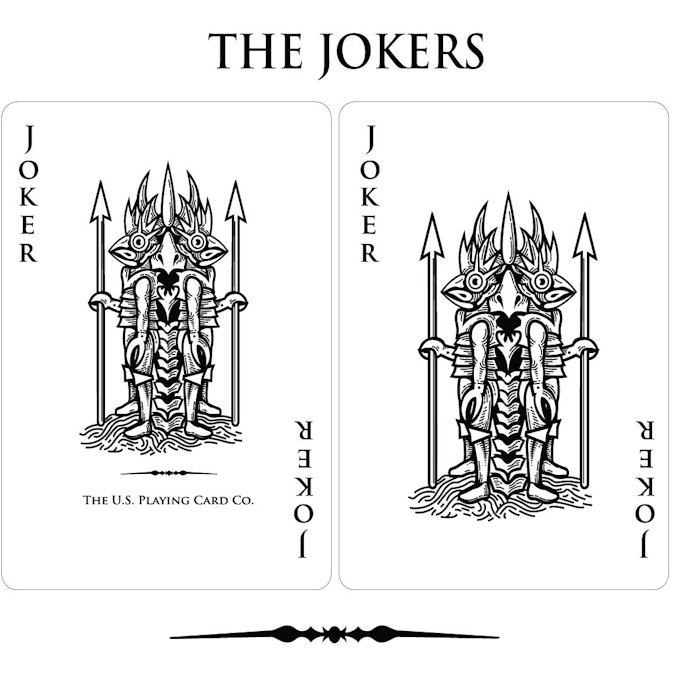
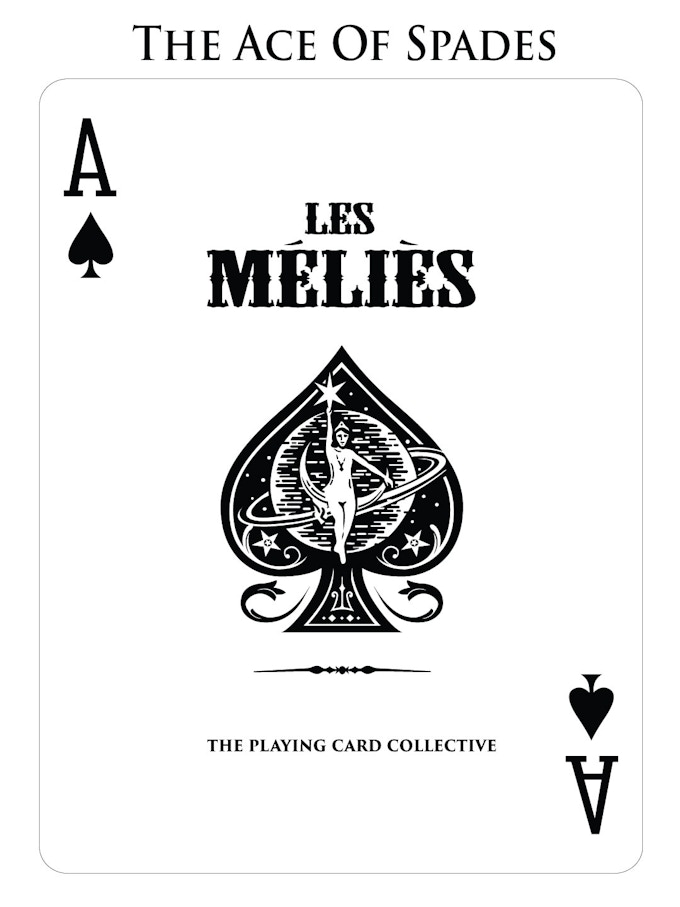
Here are images of the Méliés Playing Card design courtesy of the project's Kickstarter page:


© all rights reserved
Kardify 2013