Responsive Ad Slot

Revealed: LUXX Playing Cards Part II


This is the second part of our exclusive first look of the LUXX deck from JP Playing Cards. This elegant deck was created by Randy Butterfield, designer of the successful White Ornate.

Part I featured the partial reveal of the tuck and the back. In this reveal, we have the first look at LUXX tucks and back.


This exclusive first look is provided by Paul. When asked what motivated him to create the his own deck of cards, Paul said,

"I guess it probably started when we first realised that Lawrence (LPCC) was opening up his printing company to work with third parties. His Legends decks have all been extremely popular with the majority of our regular customers and so the motivation became to produce a deck that was practical yet beautiful. An elegant deck of cards that was still something that would be opened and enjoyed. With that in mind the aim has been to go with traditional recoloured courts with a beautiful set of aces and back design. Something we can be proud of as a small family business, and a deck we'd enjoy using ourselves too. "

To be the first to know when the LUXX Playing Cards are released visit JP Playing Cards - one of the fastest growing collectible playing card stores in the World. Also, to see more exclusives and interviews, please follow us Facebook.

Kickstarter: 7 Questions with David Traina of Borderline Playing Cards


Borderline is a deck of custom playing cards that celebrate the vibrant culture on both sides of the southern border. Created by Traina Design, this lovingly crafted deck showcases bilingual designs that depict the unique culture and colorful characters seen in and around the US/Mexican border.

The face cards of Borderline features 26 unique characters that capture the rich personalities from both sides of the border. Instead of the typical kings, queens and jacks, there are bikers, luchadores, Hollywood starlets, Mexican señoritas, small town sheriffs and federalise.

We caught up with David Traina, President and Creative Director at Traina Design to talk about his company, the inspiration behind the Borderline Playing Cards, the evolution of design of the deck and Kickstarter.

Can you tell us about Traina Design and your design background?
Traina Design is a brand communications firm located in San Diego. We work with visionary companies to emphasize their strengths, establish their voice and build their business. Our clients hail from a variety of different industries and our capabilities span all aspects of customer engagement, from print to video, interactive to advertising, and social to event creative. We thrive on variety. We abhor mediocrity.

I personally started working in advertising at age 15, working summers at a large ad agency in Atlanta. After graduating from BYU, I spent a couple of years working for a small design firm in Provo. Then I moved to Seattle where I spent two years at a renowned annual report firm and three more at a full-service agency. In 2012, I moved to San Diego and not long after launched the business from my home office. Today, Traina consists of 11 full-timers and an army of contractors and partner vendors.


This is your first Kickstarter Project. Why Kickstarter?
There are two reasons why we chose to crowd fund - finances and curiosity. First, producing a deck of this quality through USPC, with its elaborate, copper foil embossed box and custom-illustrated face cards, isn’t cheap. We need the support of fellow designers and playing card enthusiasts to make this dream a reality. The second reason is pure curiosity. We've had friends launch Kickstarter campaigns, but have never been through the process ourselves. We felt that Borderline was a perfect match for Kickstarter's format, and it has been a labor of love from the beginning.

What is your inspiration behind Borderline Playing Cards? How did you come up with the idea?
For years we've wanted to design a deck of playing cards. Late last year we saw our opportunity. We tossed around dozens of ideas over the course of several weeks and finally, as we stood around our ping-pong table brainstorming one day, the idea sprouted. We decided to create a deck that features the amazing cultural heritage right in our backyard. The "mirror-image" nature of playing cards was the perfect way to contrast both the characters and the languages on either side of the U.S./Mexico border.

How much time did you spend working on the deck?
We spent three months on the design and custom illustrations. Once completed, we spent hundreds of hours producing our Kickstarter video, our image library, outreach, etc.


Can you briefly go through the design evolution of one of your unique card design?
First we spent days determining what characters to feature, and who their natural parallels should be. We considered every conceivable personality, but ultimately landed on the 14 that you see in the deck. Once we agreed on a pairing (for example, the biker vs. the luchador), rough sketches were drawn up and routed through the entire team for feedback and suggestions. It was truly a team effort, and everyone's input had equal weight. The illustrations would then go through at least half a dozen refinements before they were finally polished and ready to go.

What are your thoughts about the continuous strong growth of playing card projects on Kickstarter?
The bottom line is that designing a deck of playing cards is a pipe dream of every conscious designer, and before Kickstarter there was simply no way to get it done. There are scores of players worldwide who never knew playing cards could have so much artistic life, and Kickstarter is the ideal distribution channel to bring these two groups together. As more people discover this movement, from both a designer and player point-of-view, it's going to continue to explode.


Finally, what are your favorite playing card decks? 
Since we began this process nearly one year ago, I've been blown away by dozens of amazing decks that I've seen on Kickstarter. I love the Edgy Brothers’ Dia de los Muertos deck and I’ve always drooled over the JAQK decks. Also, as a designer, I'm a big fan of anything with typographic elegance, or anything along the lines of Hundred Million's CMYK deck.

Thank you David for your time and sharing with us your Kickstarter project! All the best!


Pledge starts from $12 and Borderline Playing Cards will be printed by the USPCC. Also, add-ons such as shirt and uncut sheet are available.


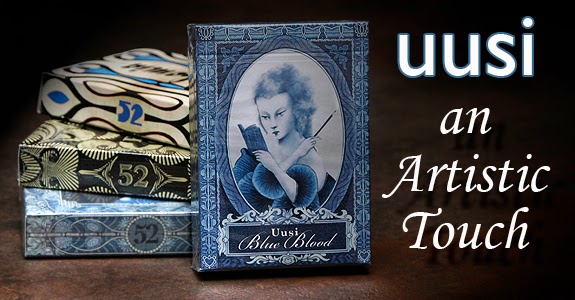
1-ON-1: Uusi


In 2010, husband and wife team Peter Dunham and Linnea Gits opened the doors to their new design studio in Chicago Illinois with a very telling idea in mind:  that life is worth the meaningful effort, and its reward is one of discovery.

That design studio was Uusi (Finnish for “new”). Their client list eventually grew to include Herman Miller, Design Within Reach, Chronicle Books, Sharpie, Draft FCB, and Prismacolor. Their work is presented in many diverse media, from Fine Art, Illustration, Graphic & Interior Design to Photography and Woodworking.

Linnea and Peter had been collecting Playing Card decks for years as inspirational objects, and in 2012, decided to design a custom deck of their own. That deck was Blue Blood, which was launched and funded on Kickstarter with huge success and accolades from their backers. Uusi had brought a long-missing Fine Art feel back to the playing card community and opened the door for a creative surge that is still going strong today.


With the success of their first deck, Uusi released their second deck, Bohemia. Its bold “Street art meets Baroque” hand-painted design was release to much of the same success and acclaim which Blue Blood had garnered. With the release of Bohemia, the studio also revealed that it and Blue Blood were the first decks in a planned six deck series, Bohemia being the second deck in the series.


In 2013 Uusi released their next 3 installments to the series, Royal Optik, Blue Blood Redux and Pagan, all via Kickstarter, and all reaching the same success and praise their previous projects had enjoyed. Royal Optik is described as the combination of two art styles “Op Art and Woodcut – coming together to create one completely original playing card deck”. Released in two color variations, Royal Optik was deck 3 in the series.


Blue Blood Redux was the next release, and marked the return of the “Indigo Monarchs” of Blue Blood to an established and new audience that may have missed out on the original Blue Blood deck. Redux was much the same deck as the original with some minor changes consisting of a new tuck box image and some changes to the court cards. They also added unique diptych cards (a “diptych is a work of art in which two image “panels” create one continuous image when joined together) and two new Aces. Redux was not meant to be one of the planned six-deck series, but more of a “companion deck” to Blue Blood. I guess we can call it deck 1B in the series. That is not an official statement, by the way. ;)


The fourth deck in the series is Pagan, returning to one of the oldest mediums in art: oil painting, and drawing inspiration from a personal place for Linnea and Peter:

“Our inspiration for Pagan came from our love of the great forests and lakes of Northern Wisconsin and Michigan's Upper Peninsula. The smell of the woods, their silence and the enormous beauty of the forests and lakes in that region of the US has always inspired us. When you are deep in the forest, the feeling of wilderness is intense - and it was that feeling that became the creative starting point for our new deck.”


The fifth deck in the series, Hotcakes, which is currently Live on Kickstarter, draws its inspiration from traditional 17th Century, full-figure (non-reversible) court cards combined with a mix of Pop Art, such as Andy Warhol’s playful style and Charles Pry’s one-off art decks and Italian designer Emilio Pucci’s pattern work. All these elements combine for a playful, colorful vision of courts of old.


Peter and Linnea were and are very busy with their current project, but still found the time to discuss aspects of their work as designers as well as what Playing Cards mean to them and what the future holds:

Uusi is about much more than Playing cards, which non-playing card project have you been most excited about, either past or present?

Peter and I began as artists and transitioned in to design about ten years ago. Our first design job was with Herman Miller, the renowned US furniture and design company, where we were contracted for a series of murals for their showroom in Chicago. They loved the work so much that we were given the job of creating murals for their National Design Centers in LA, New York and DC as well as their company headquarters in Zealand, Michigan. They also commissioned Peter for site-specific cabinetry and myself for added graphics and desktop items for their showrooms and headquarters. We continued to work in the commercial design market for private clients and large companies like Draft FCB, before starting Uusi in the fall of 2010. Our decision to start our own design studio rose from the desire to get back into the studio process again; focusing on material exploration, craftsmanship and the luxury of refining an idea outside the mainstream of the marketplace. Creating Uusi and this kind of environment has really been our favorite overall project to date!

Do you have a "Creative Process" you go through when taking on a new project?

Our Creative Process depends largely on whether it is a job for one of our clients, or a project for our own company. Client jobs come with their own set of limitations, expectations and deliverables that structure the creative process from the very start. Work for our own company tends to unfold more slowly, and is guided mainly by our passion for a genre and our intuition for what we want to see come to life there. Once we decide to pursue an idea for an object, we start by researching its history. It is important to know where something came from in order to take it somewhere else – we want to continue the conversation (so to speak) within a genre instead of just echoing what is already there.
For the playing cards we have created for Uusi, we used this research process which included not only reading about playing cards and their history, but collecting vintage decks – mainly from Europe. As we began to understand the deck's specific uses and the many ways the artwork had been created, ideas began to take shape on how we wanted to contribute to that story by adding something new to it and making it uniquely our own. At the time we got into designing custom decks – about three years ago – almost all of the new decks we saw were created using computer-based artwork. What we wanted to see was artwork created by hand and using traditional art mediums with a modern theme.

Given our Fine Art backgrounds, this was a natural path for us to take and we decided it would be cool to use as many mediums as we could to fully explore the hand-drawn line and color in the decks.

Another thing we wanted to do was change the way the tuck box was presented. So many decks use the traditional "banknote" design approach – borders that contain imagery and copy. When done well it is very appealing and just what you expect a deck's tuck to look like, but if you push the borders off the box you move into a different packaging realm and can create a more unique look and style that is distinctly your own.

Once we had decided how to approach our own contribution to this genre we were off and running. Knowing our approach to the overall process meant that each deck would have its own unique theme and a new art medium would be chosen to express that theme. The sketch process is the first step in resolving the theme and is often the longest one. Once a final direction is realized though, things move fairly quickly; final artwork is created with small adjustments in design getting worked out along the way and lastly, all artwork is transferred into a digital format for print.


Who are some of your artistic inspirations? Whose work do you really enjoy?

We draw artistic inspiration from so many things!! The natural world is a great source of inspiration as is the Fine Art world. Peter is a big history buff and also loves the mechanical side of the design process – figuring out how things work and the craft involved. With playing cards we are mostly drawn to old European decks. The colors, line work and patterns are really beautiful on these decks as were the processes that created them – chrome lithography, hand-brushed and stenciled colors right down to the way the paper was made – and led the way for so many of the decks we see in use today. We were some of the first designers to employ hand drawn imagery for the artwork in our decks and it has been very cool to see many of the designers that have entered the market after us appreciate that approach and try to incorporate an element of hand drawn work in their decks as well. But ultimately, the way you make your art really doesn't matter as much as your ability to express what it is you want to say successfully – for us it just so happened that a more traditional process was the best one.


There is a question that seems to be on many Playing Card aficionados’ minds as of late. Uusi had gone into this card series stating it would consist of six decks. Well, we're getting close to the end of that series...will we see Uusi deck designs after this series reaches its end?

Well...I guess the rule of thumb here is to say, "never say never"! But in all honesty, this series has taken an enormous amount of time to create and there are definitely other projects we have been itching to get to at the studio. We just signed a licensing contract with the wonderful, Brooklyn-based design manufacturer, Areaware, for our wood animals sets that we are really excited about and for whom we will also be designing other objects and functional items for the home. So I think when deck number six is finally finished and shipped we will feel a great sense of accomplishment in having created such a considered catalog of work, but we will also feel an equal amount of relief to be at its end. I am sure we will always remember this experience as one of the most enjoyable we have had as designers – but since we are not at the finish line yet! - and we are still very much immersed in this community, we are mostly just enjoying it as it is unfolding and whatever the future brings it brings. We hope after we are finished with this series though, we still can participate on some level with the people and companies we have gotten to know and respect and who have made this whole journey so much more enjoyable!


I can’t thank Peter and Linnea enough for their time and collaboration on putting this piece together. Uusi truly has its own unique vision and style, and it’s evident not only in the five decks that they’ve brought to us so far, but in their non-playing card work as well.

If you would like to learn more about Uusi and the work they do, you can visit them on their website or on Facebook.  And don’t forget to check out the newly released Hotcakes Playing Cards now Live on Kickstarter!

This exclusive 1-on-1 is written by Anthony Ingrassia for kardify. No part of this article can be reproduced without written permission from the author. You can check out Anthony's awesome collection at sparkzcollector.

Kickstarter: 7 Questions with Benji Taylor of ICON Playing Cards


ICON Playing Cards is created by a talented young cardist, Benji Taylor. This minimal, simple and quirky deck came together when Benji realised from his sketchbook that some weird random icons when put together could make a stylish deck design.

Benji was nice enough to have a chat with us about his design background, the inspiration & design evolution of the Icon and support from the playing card community.

Can you tell us about yourself and what is your design background?
My mum is an artist and so growing up I have been able to experience that world quite a bit from art fairs etc. I have also always loved to draw, just random doodles mainly. It was only after I got my laptop that I really started to experiment with different types of design. The internet is amazing for me, it's a great way to be inspired and also learn pretty much everything you need to know about what ever you want to know about, the rest is just practise!

You are an amazing cardist! What motivated you to create your own deck of cards? 
Haha, thanks! I think it was when I went into my local magic shop and picked up an awesome deck I had never seen before. I asked the guy working there who had made them and he said it was an independent design by one person on Kickstarter. I had backed projects on KS before but had never though to search up playing cards let alone design my own deck. After that I knew I wanted to do it.


What is your inspiration behind Icon? How did you come up with the idea?
I couldn't think of a solid theme, I had all these ideas in my head that could of worked but I also didn't want to limit myself to one solid thing. I drew down a bunch of little ideas in a sketchbook, when I looked back at them and saw what were all these random icons, I decided that if I couldn't choose one that I liked best, I would use every single one that I had done! I drew them out neat, scanned them in, went over them and then put them all onto a back design! That is how Icons came about.

How much time did you spend working on the deck and can you briefly go through the design evolution of one of your unique card design?
In total, I probably spent near to 5 months designing this deck. Everything else aside, just focusing on design, around 5 months. Some might think that is quite long considering it is not fully custom and is just the ace, box, back and jokers but I wanted every detail, every letter space on the tuck, to be just the way I wanted it. I also kept coming back to it, I would save something and then a day later change it all again till I was happy. It took me a long time just to get the colour the exact shade I wanted it! (it doesn't help that I am colour blind either..) Originally it was going to be a one way back with different icons than there are now, and was going to be a dark brown... This just shows how much things can change from the first try to the final product.


We initially noticed Icons on your Instagram account. What do you think of the playing card community and the support that you’ve been getting so far?
The response from icons has been overwhelming and generally amazing from the word go. When my good friend Franky Morales and I shared the first photo on Instagram we started getting lots of messages and comments asking where they could buy one of these decks. We released photos bit by bit and tried to not give too much away. Over time we developed a big group of people who were incredibly supportive and kind who are now the people backing the deck. One thing I have learnt along the way is that you cannot please everyone and this is a very valuable lesson to learn. You cannot keep changing things until you please everyone because you simply cannot please everyone. If you are truly proud of something you have done then be proud of it. All in all I think the community is great, they are supportive, communicative and kind and I hope it will all continue to grow.

What are your thoughts about some concerns regarding the shipping and fulfilment of Icon?
With the help of my whole family the idea will hopefully be to create a human conveyor belt and get everything packaged and sent as soon as possible. I think problems with shipping will always arise and it's not always possible to stop these things from occurring but I will make sure to work around these issues so that every backer gets what they have pledged for and is satisfied.


Finally, what are your favourite playing card decks?
My favourite decks... I would have to say.. Absolut Vodka, Fulton's China Town, Virts, Watermelons and Private Reserve? Those are just a few, I have so many!

Thank you for your time Benji and all the best! If you like what you’ve read here and want to support the Icon Playing Cards, you can find it on Kickstarter here


This deck will be printed by the USPCC with linen finish. Pledge starts from $16 and there are multiple add-ons available such as Icon t-shirt, Icon Anything is Possible bottle by Jamie D. Grant and Joe Porper Card Clip.


© all rights reserved
Kardify 2013